Key takeaway
If childhood vaccination records are missing or incomplete, review available documents with a clinician, identify genuine gaps, and discuss an individual catch-up plan based on cur...

If your childhood vaccination record is incomplete, uncertain or unavailable, it does not automatically mean that you are unprotected or that you need every vaccine again. It means your vaccination history needs a careful review. Adults may have missed doses because records were lost, families moved, clinics changed, illness interrupted a schedule, or vaccines were not available or routinely offered at the time.
A catch-up vaccination plan is a way to identify important gaps and decide what, if anything, should be given now. The plan should be based on reliable records where possible, your age, previous illnesses or vaccines, health conditions, pregnancy status, work, travel and other exposure risks, and current local recommendations.
There is no single catch-up schedule that fits every adult. A clinician can help separate documented doses from uncertain history, decide whether any laboratory testing is useful, and discuss the benefits, limitations and safety considerations of vaccination. The aim is to make an informed plan without unnecessary repetition or delay.
Vaccination protection can remain important in adulthood. Some vaccine-preventable infections can cause severe illness, complications or outbreaks, and adults may also expose infants, older people or people with weakened immunity.
Missing records can create uncertainty during travel, employment, higher education, pregnancy planning or healthcare work. Reviewing the history before a need becomes urgent can reduce confusion and help avoid missed opportunities. Catch-up vaccination may close genuine gaps, but it should be based on current guidance rather than guesswork. In India, adult vaccination recommendations are not organised as one universal national schedule for every situation, so individual clinical review is especially useful when childhood records are incomplete.
An adult may benefit from a vaccination-record review if there is no written childhood record, only part of the record is available, or the dates and vaccine names are unclear. Review may also be useful after moving between states or countries, changing healthcare systems, or receiving vaccines from several clinics that did not share records.
People entering healthcare, laboratory work, childcare, education or other settings with infection exposure may need clearer documentation. Travellers, people preparing for pregnancy, and adults with certain long-term illnesses may also have additional considerations. People taking medicines that suppress the immune system, living without a functioning spleen, receiving cancer treatment, or preparing for organ or stem-cell transplantation require specialist review because vaccine choices and timing can differ.
The same applies after an outbreak or a known exposure, when public-health advice may affect what is recommended. A catch-up discussion is not limited to people who are certain they missed vaccines; it can also help those who simply cannot confirm what they received.
The first “screening test” is usually not a blood test. It is a structured review of available information. Bring any vaccination cards, old clinic records, discharge papers, school or college health documents, travel certificates, employer records, and digital health information that may contain vaccination dates. Family members may also have saved childhood records.
A clinician will look for documented vaccine names, dates and series already started. Credible written documentation is generally more useful than memory alone. Long gaps between doses do not automatically mean that a previously started vaccine series must be restarted; the clinician can check current guidance for the specific vaccine.
Blood tests, sometimes called serology, can show immunity to certain infections in selected situations. However, they are not a universal way to reconstruct a complete vaccination history. Tests are not available, useful or reliable for proving protection after every vaccine, and their interpretation may depend on the disease and the laboratory method.
The review may also include pregnancy status, allergies, immune-system conditions, medicines, previous serious vaccine reactions, travel plans and occupational risk. These details help determine whether vaccination, testing, deferral or specialist advice is appropriate.
A careful catch-up review can identify genuine gaps, reduce avoidable susceptibility to vaccine-preventable disease, and create a clearer record for future healthcare, travel, study or work. It can also prevent unnecessary restarting of vaccine series when valid previous doses are documented.
There are limits. Old records may never be found, and memory cannot confirm exact products or dates. Blood tests cannot reliably answer every question, and some testing may add cost without changing the plan. Recommendations also differ by country, age, medical condition, pregnancy status, occupation and exposure risk.
Receiving a vaccine again may sometimes be considered when records cannot be confirmed, but that decision depends on the vaccine and the person. A clinician should balance likely benefit, safety, available evidence and current local guidance rather than using a universal catch-up list for all adults.
Vaccines, like other medicines, can cause side effects. Common reactions after many injected vaccines include pain, redness or swelling at the injection site, tiredness, headache, muscle aches or a mild fever. These are usually short-lived. The exact side-effect pattern depends on the vaccine.
Serious reactions are uncommon, but a severe allergic reaction can occur rarely. A previous severe allergic reaction to a vaccine or one of its components must be discussed before another dose is given. Certain live vaccines may not be suitable during pregnancy or for some people with significant immune suppression. Recent illness, specific medicines, transplantation, cancer treatment and other medical conditions can also affect timing or choice.
Repeating a dose when the history is uncertain is not automatically dangerous, but unnecessary doses may add cost and increase the chance of local reactions. This is another reason to review records first.
Tell the clinician about previous severe vaccine reactions, fainting after injections, known allergies, pregnancy or possible pregnancy, and medicines that affect immunity. The clinic can then use the appropriate precautions and observation.
The best way to prevent future uncertainty is to build one reliable vaccination record and keep it updated. Start by collecting whatever evidence is available from previous clinics, hospitals, schools, colleges, employers, travel documents, family files and any digital immunisation or health record you can access. Do not discard older records simply because they are incomplete.
At the appointment, separate information into three groups: clearly documented doses, doses that appear to be missing, and doses that remain uncertain. If no records can be found, tell the clinician rather than trying to recreate dates from memory.
The clinician can then compare your history with current guidance that applies to your age, health, pregnancy status, occupation, travel and other risks. Some people may need vaccination, some may need selected testing, and others may already have sufficient evidence of protection. Avoid using a childhood schedule copied from the internet as an adult catch-up plan.
After any vaccination, ask for the date, vaccine name and other available documentation to be added to your record. Keep a personal copy in a secure place and, where available, ensure the dose is also entered into the relevant clinic or digital record.
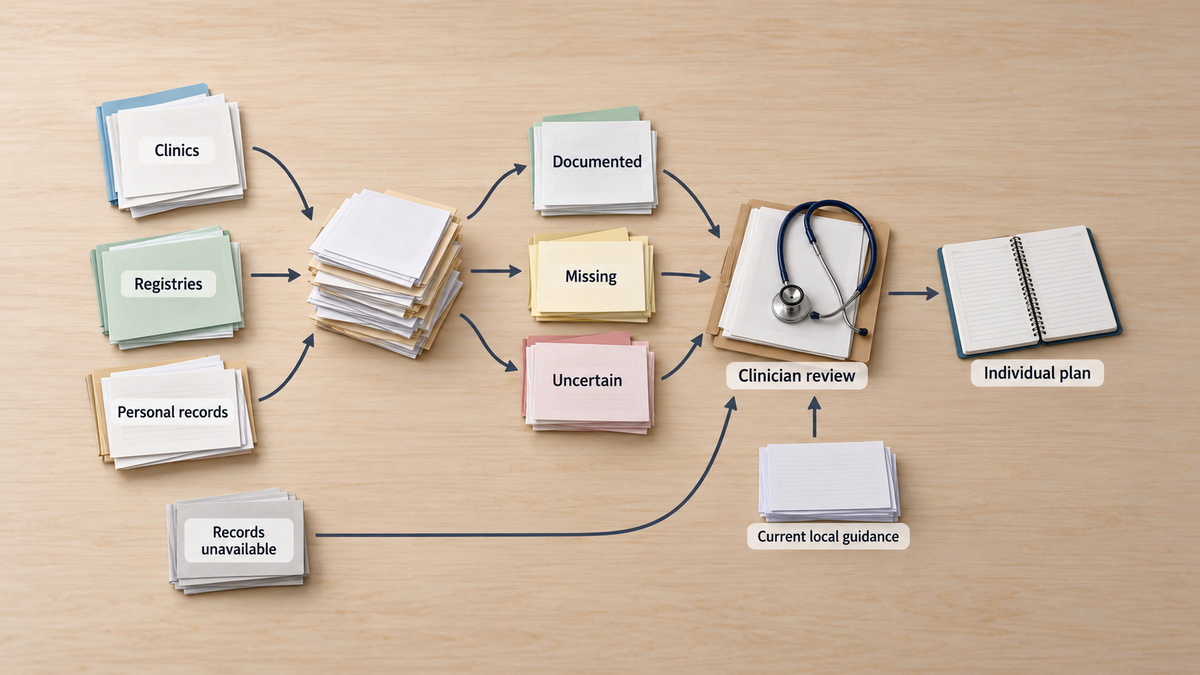
If a catch-up plan requires more than one visit, note the next review date and keep the same record with you. Do not assume that a delay between visits means the entire series must start again. Contact the clinic if an appointment is missed so the plan can be continued according to current guidance.
After vaccination, mild soreness or a short period of tiredness may occur. Follow the clinic’s general after-care advice and seek medical guidance if symptoms are severe, unusual, worsening or do not settle as expected.
At later health visits, show your updated vaccination record, especially if you change doctors, become pregnant, start immune-suppressing treatment, develop a major new medical condition, plan international travel or begin work with special exposure requirements. These changes can alter vaccination considerations.
Keep both a secure paper or downloaded copy and, if available, a digital record. When different records disagree, do not edit them yourself to make them match. Bring both versions to a healthcare professional so the discrepancy can be reviewed and the most reliable information retained.
Arrange a clinician review before catch-up vaccination if you are pregnant or may be pregnant, have a weakened immune system, take immune-suppressing medicines, have had a severe reaction to a previous vaccine, are receiving cancer treatment, have recently had a transplant, or have a complex medical history. These situations may affect which vaccines are appropriate and when.
Seek urgent medical care after vaccination for possible severe allergic-reaction symptoms such as difficulty breathing, swelling of the face or throat, widespread hives, marked dizziness, collapse or rapidly worsening weakness. These reactions are rare but need prompt treatment.
For other symptoms that are severe, persistent or concerning, contact the vaccination clinic or another qualified healthcare professional. If the question relates to a disease outbreak, a recent exposure or urgent international travel, seek advice promptly because timing may matter.
Myth: Vaccines are only for children. Fact: Vaccination can remain relevant throughout life, depending on age, health, risk and previous vaccination.
Myth: If childhood records are missing, every vaccine series must start again. Fact: A clinician reviews documented doses and current guidance. Long gaps do not automatically erase valid earlier doses.
Myth: A blood test can reveal every vaccine you have ever received. Fact: Serology can help in selected situations, but it cannot reliably reconstruct a complete vaccination history.
Myth: An uncertain record means you should copy a catch-up schedule from the internet. Fact: Adult catch-up decisions depend on individual circumstances and local recommendations.
Myth: Mild soreness after a vaccine means something went wrong. Fact: Short-lived local discomfort and other mild reactions are common with many vaccines.
Related articles

Premature Skin Ageing in Young Adults: Common Causes, Prevention and When to Seek Advice
07 Aug 2026

Acne: Understanding Common Types, Skin-Care Basics, and When to See a Dermatologist
06 Aug 2026

Acidity and Indigestion: Common Triggers, Self-Care Steps and When to Seek Medical Advice
05 Aug 2026
Acidity and Indigestion: Common Triggers, Self-Care Steps and When to Seek Medical Advice
05 Aug 2026